“Please choose the facts they want now!” From The Newsroom
Introduction
I’ve thought a lot about the nature of “truth” recently. This post is part one of a currently unknown number of articles on the topic.
Before you read on, here are some warnings. I don’t contend that I am the first person to have reached these conclusions or espouse these (or similar) views on “truth.” I suppose that all opinions are just half-baked regurgitations of what we’ve absorbed from people much smarter than ourselves.
In these articles, I will attempt to document my understanding of the topic, as shallow and misguided as that understanding may be, for the half-dozen or so people who accidentally stumble across this blog.
Also, this series of articles will be quite dense (and very “meta”). If you’re not into that sort of thing, stop reading.
Many philosophers would tell you that there was no such thing as “truth” to begin with.
I don’t purport to be an expert on philosophy or epistemology. But I do hold myself out to be an expert on law and political science. I have obtained advanced degrees in both fields. (And if you don’t think that makes me an expert, that is indicative of a larger problem.)
This post is about “truth” in politics. Or perhaps more specifically, in the body politic — “a group of persons politically organized under a single governmental authority.”
When I say “truth,” I mean a verifiable or falsifiable state of objective “facts.” (Don’t argue with me about whether “facts” can ever be truly “objective.” If you don’t agree with the premise, stop reading.)
Every day, lawyers use their formal training to sort through “facts” in pursuit of “truth.” Until the “facts” are verified or falsified (i.e., proven, objectively, to be a correct or incorrect representation of the state of something), then we do not present something as the “truth.”
Sometimes, people acting in good faith cannot agree about whether a given state of “facts” has been conclusively verified or falsified because there is conflicting evidence about the state of that “fact.” Therefore, an honest disagreement may exist about the “truth.”
We ultimately choose to accept those “facts” that we believe, acting in good faith, have been sufficiently verified or falsified.
Lawyers then construct and present their “truth” as a “narrative.” We compile and editorialize the universe of “facts” we think are important and present them to the listener. We call attention to “facts” we do not think have been sufficiently verified or falsified based on the evidence. We argue that certain “facts” are more or less important than other “facts.”
At the end of the day, the law (usually) prevents lawyers and litigants from outright fabricating “facts” — that is, knowingly and falsely claiming that a “fact” has been verified or falsified when it has not been.
So, what about “truth” in the body politic?
We often hear cynical pundits say we are living in a “post-truth” world. I disagree. We are living in a “post-fact” world.
In this “post-fact” world, presenting a “narrative” based on what someone wants the “truth” to be is more important than the verified or falsified nature of the “facts” upon which that “truth” has been constructed.
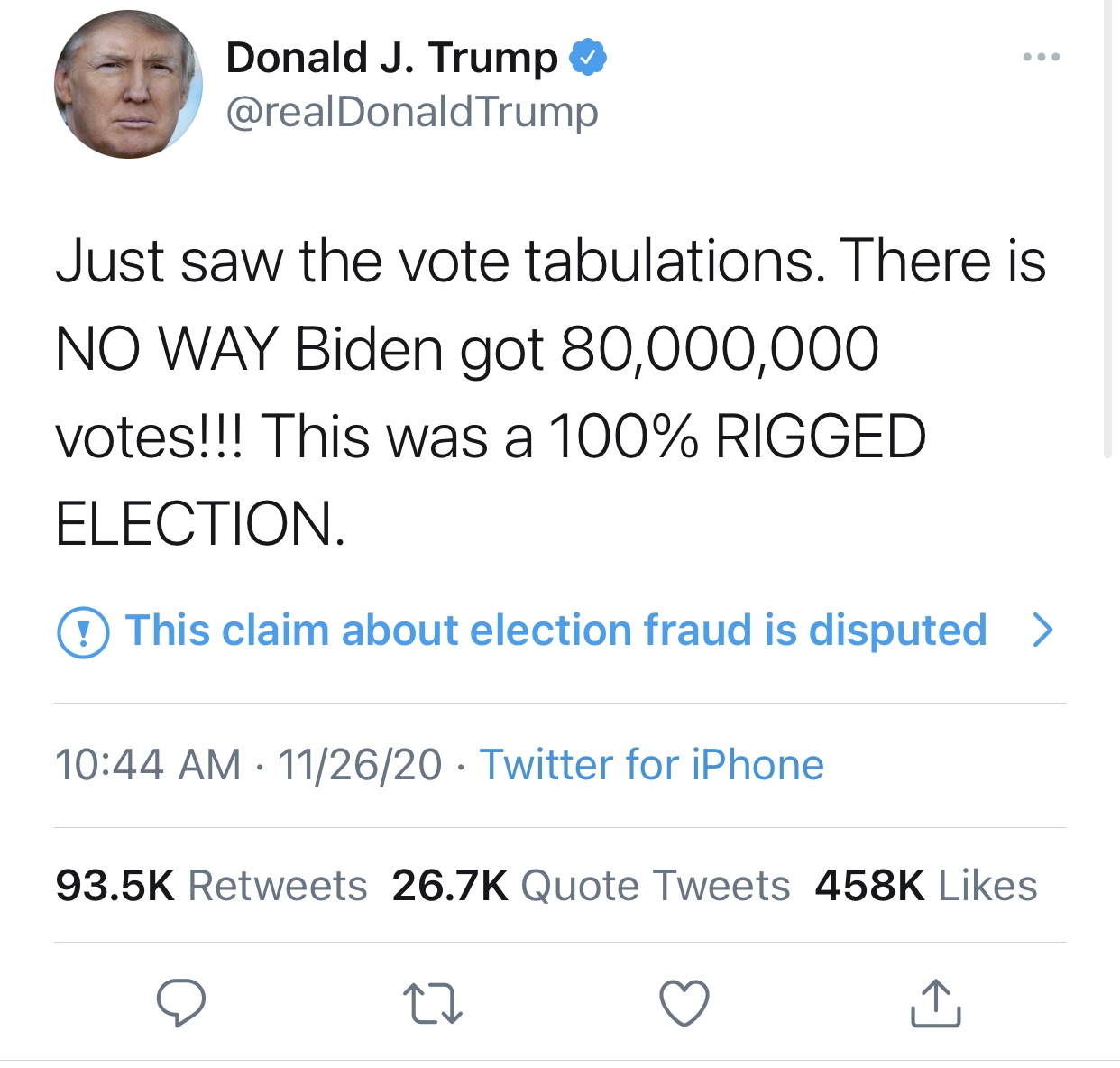
Add to that miserable state of affairs the following aggravating factors. Agents of chaos purposefully inject our public spaces with deliberately incorrect “facts.” Candidates put their political interests and ego above the sanctity of civil debate. Pundits place their commercial interests above societal interests in agreeing about “truths” that should be indisputably based on the state of objective “facts.”
We now live in a time when people can be presented with unimpeachable evidence that a given “fact” is verified or falsified, and still refuse to acknowledge the state of that fact — whether through maliciousness, ignorance, or willful blindness to the evidence or lack thereof.
Or, as the case may be, because they have conditioned themselves into believing that only the persons they choose to associate with know the real “truth.”
What caused this to happen? Blame the internet. Blame the Russians. Blame the Chinese. Blame the Republicans. Blame the Democrats. Blame the politicians. Blame the “deep state.” Blame the Koch brothers. Blame George Soros.
But more aptly, blame ourselves. The sad “truth” is that it’s easier to let someone spoon-feed us the “narratives” that we already tend to believe are “true,” rather than independently scrutinizing the evidentiary basis for the “facts” upon which that supposed “truth” is based.
We must always approach “narratives” with a skeptical mind and invoke “Hitchens’ Razor” at every opportunity — “Extraordinary claims require extraordinary proof.”
Or, in our case, extraordinary “narratives” must be based on verified or falsified objective “facts.” (Hitchens’ Razor is definitely catchier.)

 the irked moderate